


The Luxury Literary Itinerary of Britain

Literary tourism is having a moment. From travellers visiting the filming locations of their favourite television series to readers planning entire holidays around beloved novels, stories are increasingly shaping where we choose to travel.
Now, luxury tour operator TCS World Travel has introduced a new 10-day journey through Britain, designed for travellers who want to experience the places that inspired some of the world's most celebrated writers.
Titled Britain's Literary Landmarks: A Storybook Journey from London to Edinburgh, the itinerary connects England and Scotland's literary heritage through historic libraries, famous authors' homes, atmospheric landscapes and privately guided experiences.
The launch comes amid renewed interest in Virginia Evans' novel The Correspondent, which is being adapted for the big screen with Jane Fonda attached to star. The novel draws inspiration from the tradition of literary correspondence, including Helene Hanff's 84, Charing Cross Road, making London's historic bookshops a particularly fitting starting point for the journey.
But this isn't simply a sightseeing holiday. The fully customised itinerary is designed to take travellers deeper into the places, people and stories that have shaped British literature, from Shakespeare and Lewis Carroll to William Wordsworth and J.K. Rowling.
London: Bookshops, Sherlock Holmes and Shakespeare
The literary journey begins in London, a city whose streets have provided the setting for centuries of fiction.
One of the first stops is 84 Charing Cross Road, the former address of Marks & Co., an antiquarian bookshop immortalised in Helene Hanff's celebrated collection of letters, 84, Charing Cross Road.
Although the original bookshop has long since closed, its story remains one of literature's most enduring celebrations of the relationship between readers, booksellers and the written word.
For fans of The Correspondent, the location offers a connection to the literary inspiration behind Evans' novel.
From here, travellers explore London's literary neighbourhoods in a classic Mini Cooper, visiting locations associated with some of Britain's most recognisable fictional characters and writers.
Highlights include Bloomsbury, once home to Virginia Woolf and the influential Bloomsbury Group, and 221B Baker Street, the fictional address of Arthur Conan Doyle's detective Sherlock Holmes.
The itinerary also includes a visit to the Peter Pan statue in Kensington Gardens, celebrating J.M. Barrie's much-loved character, and Highgate Cemetery, where writers and thinkers including George Eliot and Karl Marx are buried.
One of the standout experiences is a behind-the-scenes visit to Shakespeare's Globe, accompanied by a Shakespearean expert.
The reconstructed Elizabethan theatre on London's South Bank offers visitors an opportunity to discover how Shakespeare's plays were originally performed, exploring the architecture, theatrical traditions and enduring influence of the playwright's work.
For visitors who have only encountered Shakespeare in classrooms or on screen, experiencing the Globe brings an entirely different perspective to his writing.
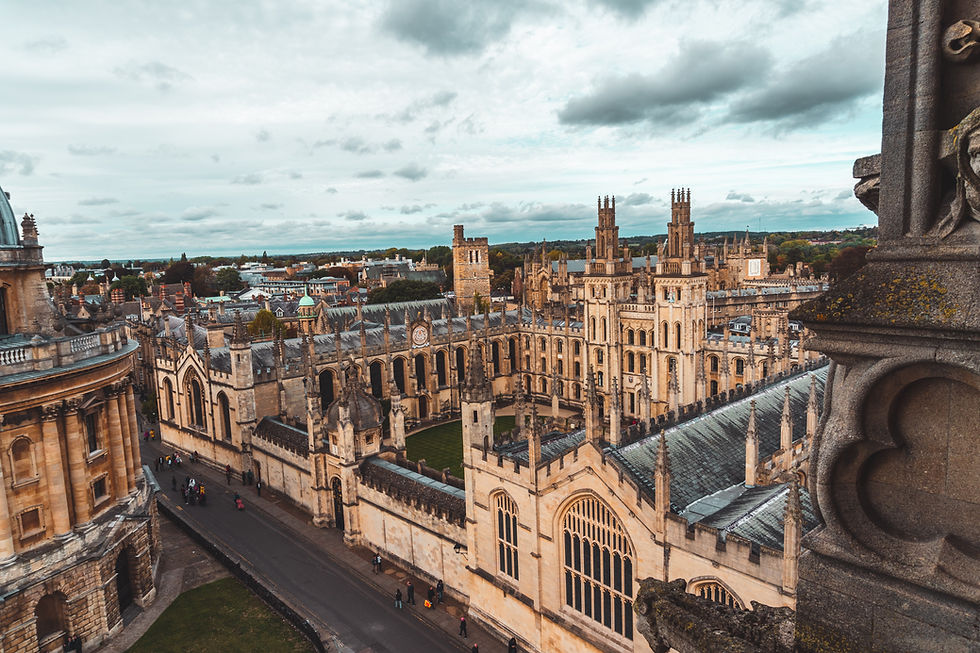
Oxford and the Cotswolds: Alice in Wonderland, Tolkien and C.S. Lewis
Leaving London, the journey continues to Oxford and the Cotswolds, two destinations
closely associated with Britain's literary imagination.
Oxford's historic colleges, cobbled streets and libraries have inspired generations of writers, including Lewis Carroll, J.R.R. Tolkien and C.S. Lewis.
Carroll, whose real name was Charles Lutwidge Dodgson, was a mathematics lecturer at Christ Church, Oxford, where his friendship with Alice Liddell helped inspire Alice's Adventures in Wonderland.
Tolkien, meanwhile, spent much of his academic career in Oxford, developing the mythology that would become The Hobbit and The Lord of the Rings.
Together with C.S. Lewis, author of The Chronicles of Narnia, Tolkien belonged to the Inklings, an informal literary group that met regularly to discuss manuscripts, mythology and storytelling.
A visit to Oxford's Bodleian Library, one of Europe's oldest libraries, forms part of the itinerary.
With its historic reading rooms, extraordinary collections and centuries of academic history, the Bodleian offers a fascinating glimpse into the world of scholarship and storytelling.
The journey also explores the Cotswolds, a region of honey-coloured villages, rolling countryside and historic market towns that seems almost purpose-built for a literary escape.
Its traditional English landscapes provide a quieter contrast to London and Oxford, allowing travellers to experience the countryside that has influenced generations of British writers.

The Lake District: Discovering the Worlds of Wordsworth and Beatrix Potter
For many book lovers, the Lake District represents one of Britain's most evocative literary landscapes.
Its mountains, lakes, woodlands and villages have inspired poets, novelists and artists for centuries, with William Wordsworth and Beatrix Potter among its most famous literary residents.
TCS World Travel's itinerary includes a visit to Dove Cottage, Wordsworth's former home in Grasmere.
The poet lived here between 1799 and 1808, producing some of his most celebrated work while drawing inspiration from the surrounding countryside.
Visitors can explore the modest cottage and discover how everyday life in the Lake District influenced the Romantic movement's relationship with nature.
The region also holds a special place in children's literature thanks to Beatrix Potter, whose stories of Peter Rabbit, Jemima Puddle-Duck and other animal characters were inspired by the landscapes and wildlife around her.
Potter eventually became an important conservationist, helping preserve large areas of the Lake District countryside.
Another stop introduces travellers to the world of John Ruskin, the Victorian writer, artist and social thinker whose former home, Brantwood, overlooks Coniston Water.
Ruskin's writings on art, architecture and nature influenced generations of thinkers, while his Lake District home remains closely connected to his creative and intellectual life.
For travellers interested in both literature and the outdoors, this section of the itinerary offers a chance to see how Britain's natural landscapes helped shape some of its most enduring works.

Edinburgh: Harry Potter, Historic Streets and a UNESCO City of Literature
The final destination is Edinburgh, which became the world's first UNESCO City of Literature in 2004.
Scotland's capital has a particularly rich literary identity, from the historical novels of Sir Walter Scott to the detective fiction of Ian Rankin and the contemporary phenomenon of Harry Potter.
TCS World Travel's itinerary includes a private exploration of Edinburgh's atmospheric Old Town, where narrow closes, historic buildings and centuries-old streets have inspired countless stories.
Among the highlights is the Writers' Museum, dedicated to three of Scotland's literary giants: Robert Burns, Sir Walter Scott and Robert Louis Stevenson.
Travellers also visit Greyfriars Kirkyard, the historic cemetery associated with Edinburgh's literary folklore and often included on Harry Potter-themed walking tours.
Another stop is The Elephant House, the café famously associated with J.K. Rowling's early writing career. Although Rowling wrote in several Edinburgh locations, the café has become one of the city's best-known literary landmarks, attracting readers keen to discover the places connected to the creation of the wizarding world.
The experience concludes with afternoon tea at the historic Signet Library, an elegant Georgian building close to the Royal Mile. With its grand interiors and long association with Scottish legal and intellectual history, the library provides a fitting finale to a journey celebrating Britain's literary heritage.

Why Literary Tourism Is Becoming a Major Travel Trend
Literary tourism, sometimes called a bookcation, is part of a wider shift towards holidays built around personal interests and cultural experiences.
Rather than simply visiting a destination's best-known attractions, travellers are increasingly looking for meaningful connections to the stories, films, music and creative works they love.
The related trend of set-jetting, which involves travelling to destinations featured in films and television programmes, has already helped turn locations associated with productions such as Bridgerton, The White Lotus and Harry Potter into major travel draws.
Book-inspired travel takes that concept a step further, allowing readers to explore not only fictional settings but also the real places where authors lived, worked and found inspiration.
For luxury travellers, the appeal often lies in access to specialist guides, personalised experiences and opportunities to explore historic locations beyond the standard tourist itinerary.
TCS World Travel's new British literary journey combines these elements in a single itinerary, linking several of the country's most important literary destinations.
Travellers interested in the itinerary can find further information through TCS World Travel.


Comments